
 4:50 AM
 Jo-Anne Rowney

Westminster is home to 35 ethnic chaplaincies. As Catholics around the world share the joy of Christ’s Resurrection, Jo-Anne Rowney discovers the wide variety of ways Easter is celebrated at home and in Church in other countries.
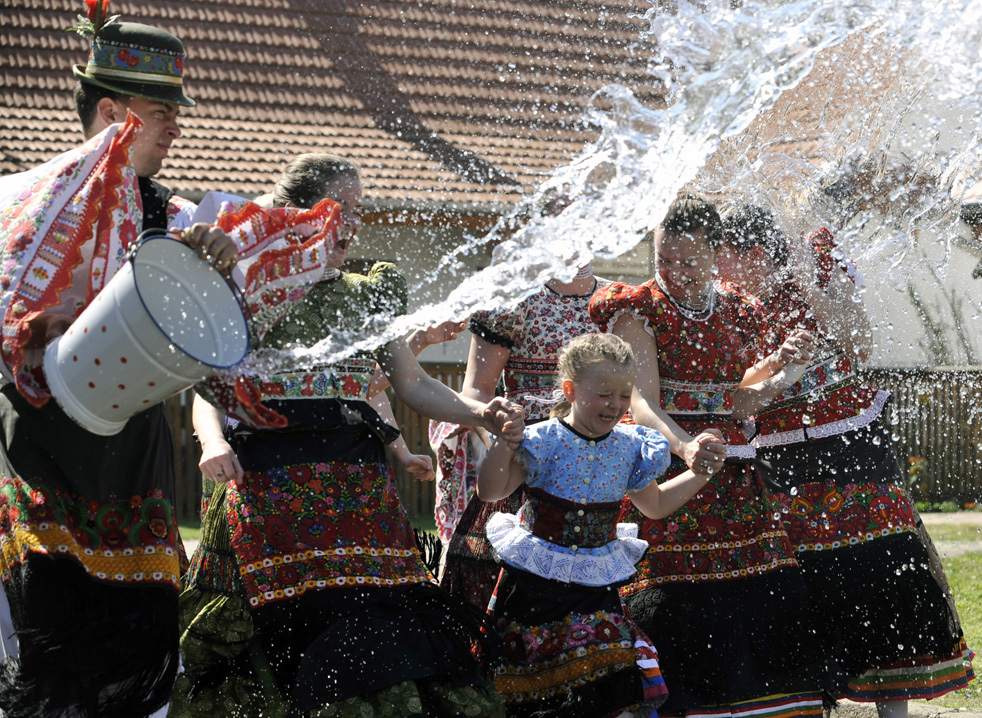 |
| A Slovakian Easter soaking |
Easter in Slovakia begins on Maundy Thursday which is also called ‘Green Thursday’, so called because people eat only vegetables.
On Good Friday a statue of the body of Jesus lain out in the tomb with flowers surrounding him is set out in the church. The Eucharist is covered in velum, so it can be seen but not visible - a symbol of Jesus being present though dead.
On Saturday, families gather in Church to meditate at the grave before the Vigil. After the Vigil a medieval drama depicting the Resurrection is performed. The altar becomes a symbol of God’s grace, dressed with a white cloth - a symbol he is alive. The Choir acts as the people and angels from heaven, singing in chorus. The priest carries a medieval cross, representing Jesus.
Following the drama, there is the ‘Rite of Resurrection’ starting with a dialogue between Jesus, God and the people. The parish and priest then process around the Church, singing a song, called ‘Lord Jesus Christ has risen from the dead’, which tells the whole story of the Resurrection, beginning with the women at the tomb. In villages they process around the Square. The song has always been in Slovakian rather than Latin, so it can be sung by everyone.
On Easter Monday, boys visit girls with a bucket of water, soaking them. They also bring a branch made of willow plaited together, which they use to hit them gently. This is a symbol of awakening. Younger children treat it like a game; the girls count how many boys visit them, and tie a plait on to the branch after being hit, so the boys can see how many girls they’ve visited.
On Easter Sunday parishioners bring decorated baskets to Church full of ham, eggs, bread and cakes in a clean cloth. The priest says a special Easter blessing. After Mass, people take the basket home to eat as nothing can be wasted. People offer the food to visitors as their best food.
Brazil
Easter begins with the Lava-pés (Washing of the Feet), this is similar to England’s custom where 12 people have their feet washed by the priest. On Good Friday, women carrying an image of Nossa Senhora das Dores (Virgin of Sorrows) meet a procession of men carrying Nosso Senhor dos Passos, an image of Christ burdened by His cross. During the procession they sing the Canto da Verônica (Veronica's Chant). The chant is symbolic of the apochryphal passage, in which Veronica wiped Christ's face on the Via Dolorosa.
On the Holy Saturday a Paschal Vigil is held. During the vigil the lighting of a new fire takes place. This will, in turn, light the Easter Candle, symbol of Jesus Christ's light unto the world.
One of the most beautiful traditions in Holy Week is the decoration of streets for the Sunday procession. Many cities do it for Corpus Christi, but in Ouro Preto, for example, people create colourful carpets with wood shavings, flour, coffee, flowers and other elements the night before Sunday for the procession to walk on. On the Sunday, the day begins with a festive procession where people come to the Church for a joyous Mass.
 |
| A fiery start to Easter in Florence |
• In Florence, Scoppio del carro, a holy fire is lit from stone shards from the Holy Sepulchre. This is then used to ignite a rocket shaped like a dove; representing peace and the Holy Spirit. A cart is lit to create a show outside the Cathedral.
• Church bells are silent as a sign of mourning for one or more days before Easter in Netherland, Belgium, France. The story is that the bells fly out of their steeples and go to Rome, explaining the silence, and return on Easter morning bringing coloured eggs.
• In Bermuda, traditional kites are made, and are flown to symbolize Christ’s ascent, the kites are made during Lent and only flown on Easter Sunday.


0 comments:
Post a Comment